
Update — May 2026: The DOE has announced a one-year enforcement delay on these standards, pushing the effective enforcement date to October 6, 2027. Read our update post here.
What building owners and facility managers need to know about the 2026 DOE Water Heater Rule…
If your facility or commercial building runs on gas-fired water heaters, a significant regulatory change is coming — and the time to start planning is now.
On October 6, 2026, new U.S. Department of Energy (DOE) efficiency standards take effect for commercial water heaters. Any product manufactured on or after October 6th must meet updated requirements – both storage and tankless models. The conventional non-condensing gas water heaters which have long been the standard in commercial buildings are being phased out. Just like this one below….
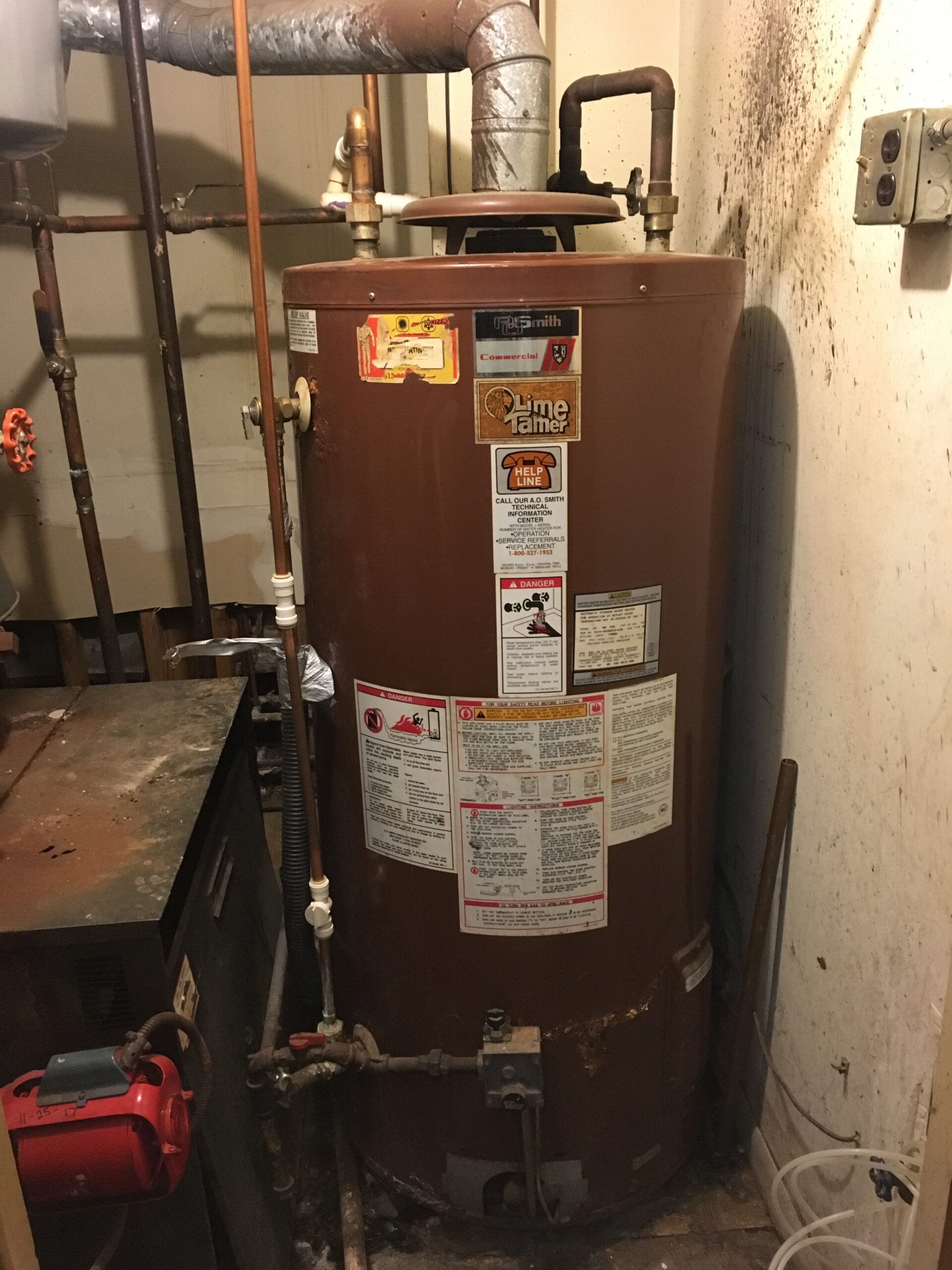
Don’t wait until an equipment failure forces your hand. Contact us today to formulate a plan and get ahead of the deadline, avoiding supply constraints and elevated costs.
What Exactly Is Changing?
The rule requires commercial gas storage water heaters to meet or exceed a Thermal Efficiency (TE) of 95%, while commercial gas tankless products and volume water heaters must meet or exceed a TE of 96%. These minimums effectively mandate the use of condensing technology. Standby loss requirements for storage products are also tightening.
It is worth noting, the DOE has determined not to propose more stringent standards for commercial electric water heaters in this rule. If your facility already relies on electric units, this particular change does not apply to you.
What Does This Mean in Practice?
The shift to condensing units is not just a paperwork change — it has real physical implications for your building. Installation of condensing water heaters will require re-piping and new venting, along with access to an outside wall for the new venting connections and a floor drain for condensate. That’s a meaningful infrastructure consideration, especially for older buildings where mechanical rooms was not designed with this equipment in mind.
The good news is the new standards are projected to save businesses and operators $140 million per year in operating costs, and the DOE estimates adoption of these standards will reduce carbon emissions by 38 million metric tons between 2026 and 2055. Higher upfront costs are real, but so is the long-term payoff.
The Supply Side Is Already Shifting
Here is a detail that catches many facility managers off guard: non-condensing water heaters can still be sold after October 2026, but only from existing inventory. Manufacturers are expected to start limiting purchases of non-condensing models months before the deadline, with June 2026 estimated as the cutoff date for distributors to order additional standard-efficiency models.
That means if your current equipment fails after mid-2026, you may not be able to get a like-for-like replacement. You’ll likely be looking at a condensing upgrade whether you planned for it or not — and potentially on a tight timeline, which can mean longer lead times and more facility downtime.
If you manage a facility in the Miami Valley, our team can assess your current equipment and help you build a realistic transition plan before the window closes. Reach out today to get started.
This Change Is Permanent
One more thing worth understanding: this is not a rule that can be walked back. Federal law includes an “anti-backsliding” provision that prevents the DOE from taking any future action that would undo an already established energy efficiency requirement. Now that condensing technology has been set as the minimum standard, it is setting up camp.
What Should You Do Now?
The facilities that will navigate this with little inconvenience are the ones who treat it as a planned capital project rather than an emergency. Start by auditing your current water heating equipment — note the age, efficiency rating, and venting configuration of each unit. Any system approaching end of life before 2027 or 2028 is a strong candidate for a proactive upgrade now, while supply and scheduling are still predictable. For units you plan to replace after the deadline, start conversations with your mechanical contractor early so venting and drainage requirements can be factored into your building’s infrastructure plans ahead of time.
The October 2026 deadline will arrive faster than it looks on the calendar, and the supply chain is already starting to reflect that reality.
Ready to Get Ahead of the Deadline?
Our team serves the Miami Valley and is ready to help you assess your current water heating infrastructure, identify which units are most at risk, and develop a transition plan that fits your property or facility’s timeline and budget. Contact us today to schedule your consultation.
For the Full Ruling and supporting documentation, visit the DOE Commercial Water Heater Equipment Page.